
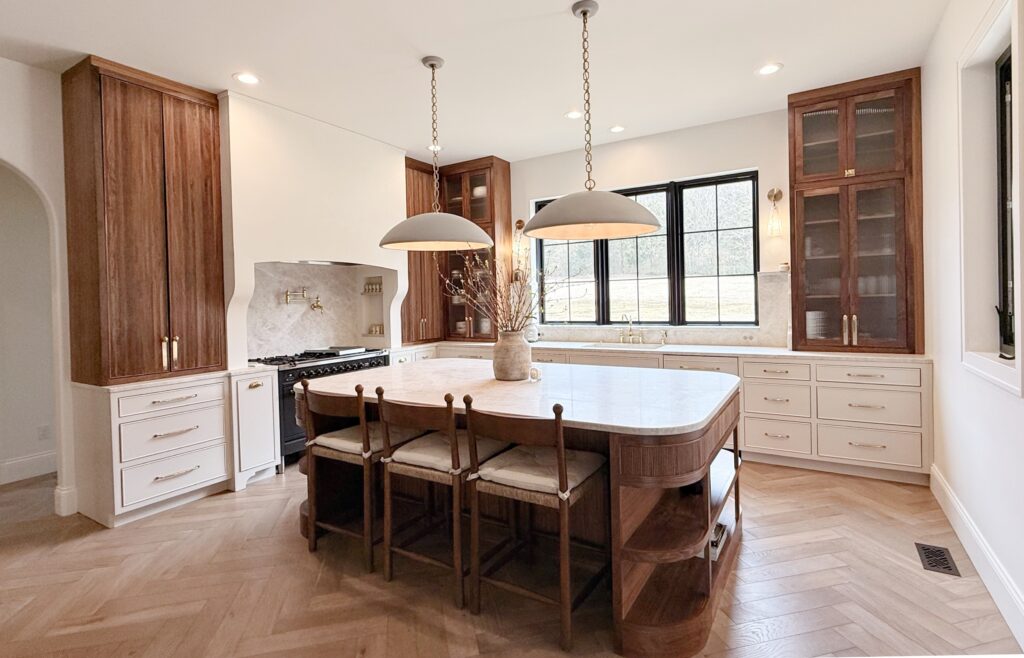
How to choose a cabinet contractor without guessing
On this page · 9 sections
Cabinets are usually the biggest single line on a kitchen, bath or closet budget, and they are also the hardest thing on that budget for a homeowner to judge. Two bids can look almost identical on paper — same room, same door style, same finish — and be built from completely different material, by completely different hands, with completely different things happening after the install crew drives away. The difference does not show up on the day of the install. It shows up in year three, when a drawer bottom sags or a door stops closing square.
So the question is not really "who is cheapest." It is "who can tell me what I am buying." A shop that fabricates its own work can answer that in plain language: what the box is made of, what species the hardwood is, who measures, who installs, and what the warranty covers. A shop that is reselling a catalogue often cannot. Below are the four questions that sort one from the other, plus a table you can take to every bid you collect.
The short answer
Bottom Line Up Front
Hire the shop that can answer four questions without hedging: what the cabinet box is made of, whether the work is built in their own shop, whether they are insured and what the warranty covers, and who measures before a price exists. A company that can answer all four in one phone call is the one to get a drawing from.
Cabinet quotes are hard to compare because the part that determines how long they last — the material and the fabrication — is the part nobody puts on the front page of a bid. Ask about it directly and the field sorts itself out quickly. The shops that build their own work will talk about plywood, hardwood species, and odd sizes all day; the ones reselling a catalogue will steer you back to door styles.
behind every job we build
delivery, and installation
from the manufacturers
The rest of this post is the reasoning behind those four questions, and a decision matrix at the end that will tell you in about ninety seconds whether the shop you are talking to is worth a second call.
Question 1: What is the cabinet box actually made of?
Ask this first, and ask it before you talk about door styles or colors. A lot of cabinetry that looks beautiful in a showroom is built from cheap sheet goods that swell the first time a dishwasher leaks or a bathroom stays humid for a week. The door is what you see; the box is what holds the door square for the next twenty years. We build ours from high quality plywood, and we will tell you exactly what is in a quote before you approve anything.
Then ask about the hardwood. A shop that works with solid hardwood should be able to name the species on the drawings without checking with anybody. If the answer is vague — "wood," "hardwood," "whatever the supplier sends" — that is not a materials spec, it is a shrug. And if a bid is dramatically lower than everything else you have collected, the material is almost always where the money came out. Pay for quality. It lasts a lot longer than the savings feel good.
Question 2: Is the work built in a shop, or ordered in?
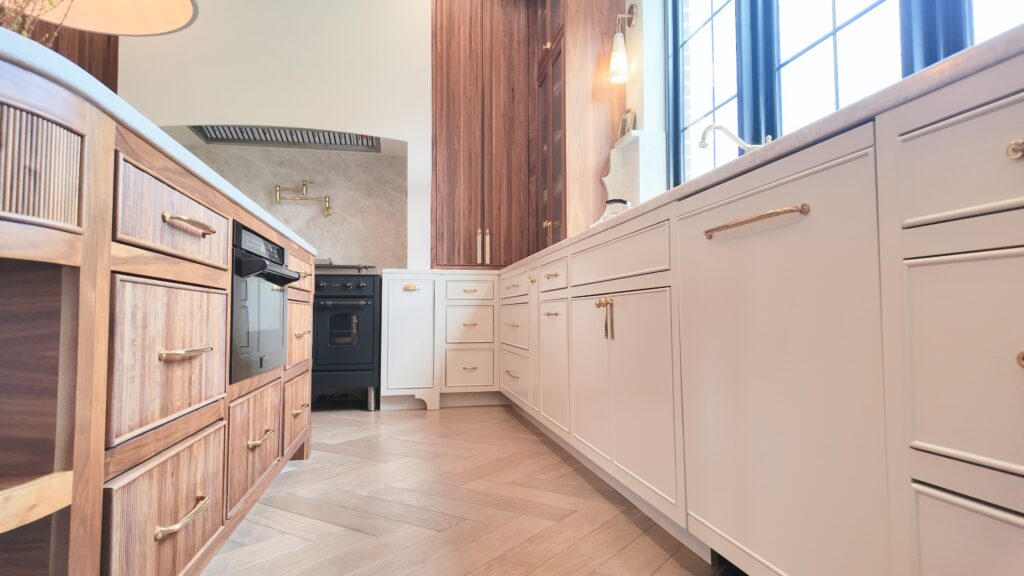
This is the question that decides how your odd walls get handled. Houses are not built in three-inch increments. There is a chimney chase in the corner, the ceiling drops two inches over the sink run, the old house has no square angle in it anywhere. A company ordering boxes from a catalogue solves that with filler strips and a scribe panel. A shop that fabricates its own work just builds the cabinet to the dimension in front of it.
We are a 100% custom shop — nothing is ordered in from overseas and odd sizes are completely normal here, whether that is a kitchen built to the walls you actually have, a vanity sized to a narrow bath, or closet and garage storage that fills the space corner to corner. It also means one team owns the job from measurement to installation, with a dedicated specialist at each step, rather than a chain of suppliers each blaming the last one for the gap.
The single fastest way to judge a cabinet company is to stand in the place where the cabinets are made. Ask to come by and look at work in progress: how the boxes are joined, how the drawers are built, how the finish is going on. A shop proud of its work will book you in. If the answer is that there is nothing to see, or that everything is "at the warehouse," you have learned something useful for free. Our shop is at 3806 Calhoon Ave, Chattanooga, TN 37407, and we are open 8am to 6pm Monday through Thursday and 8am to 5pm Friday.
Question 3: Are they insured, and what does the warranty cover?
Insurance first, because it is the one with the worst downside. Cabinet installation happens inside a finished house, around plumbing, tile, and countertops. Ask every company you are considering whether they carry insurance, and ask for it in writing rather than as a verbal yes. Anyone who is insured will send the certificate over without hesitating.
Then ask what happens if something goes wrong a year from now. There are really two warranties on a cabinet job: the workmanship, which belongs to the company that built and installed it, and the manufacturer coverage on hardware and components. Ours is a minimum of one year on workmanship, with three to four years from the manufacturers on their parts. What matters is that a shop can state both, plainly, before you sign — not that it produces a number after the fact.
The questions to ask, and the answers to listen for
This is the version we would hand you on a clipboard. Ask every shop you call the same eight questions and write the answers in the same order — the comparison gets easy fast. The highlighted cell is the one that should decide the row for you.
| What you ask | Good answer | Keep looking |
|---|---|---|
| Are you insured? | Certificate emailed the same day | "Of course" and nothing in writing |
| What is the box made of? | Named material — high quality plywood | "Standard board," no spec given |
| What hardwood do you use? | The species, on the drawings | "Whatever the supplier has" |
| Can you handle odd sizes? | Built to the dimension, no fillers | Stock sizes plus scribe panels |
| Who fabricates it? | Our own shop, here | Ordered in, often from overseas |
| What is the warranty? | Workmanship and manufacturer, stated up front | Sorted out "if anything happens" |
| When do I get a price? | After measurement and drawings | A number over the phone, sight unseen |
| Why is this bid so much lower? | Scope and material explained line by line | Cheaper material you find out about later |
These are the questions our own team gets asked, and the answers we give. Put the same eight to every shop you call and compare the replies side by side rather than the totals.
Signs you have found the right shop
Everything is specific, written down, and available to look at before you commit.
What to look for
- They send an insurance certificate without being chased for it.
- They name the box material and the hardwood species on the drawings.
- They invite you to the shop to see work in progress, not just photos.
- They measure your room and draw it before they give you a price.
Signs to keep calling
The details stay vague right up until the deposit, and then get firm.
What changes the answer
- The quote lists rooms and door styles but never says what the cabinets are built from.
- Odd walls get answered with filler strips instead of a cabinet built to size.
- The warranty is described verbally and never appears on paper.
- The price arrives before anyone has been to the house or seen a measurement.
Question 4: Who measures, and when does the estimate become a real number?
A price given over the phone before anyone has seen the room is not an estimate, it is a guess with your name on it. Our process runs the other way around: you call, we schedule a jobsite meeting, our team gathers the information and takes the measurements, and only then do the drawings and the estimate go out. You are approving a drawing of your room, not a ballpark for a room like yours.
Estimates are free. Measurements are handled case by case — if you can provide accurate measurements and information, the estimate costs you nothing at all; where we need to come out and measure and inspect the space ourselves, that part may be charged. Ask any shop how they treat that, because the ones that hide it will surprise you later. Once the estimate is approved, we are typically two to three weeks through fabrication, delivery, and installation.
When one quote comes in well under the rest for the same room, the difference is not efficiency. It is material, or it is what was left out of the scope. A lot of companies use cheap furniture-grade board and it does not last long, and by the time that shows up the company has moved on. Before you compare two numbers, make the two scopes match: same box material, same hardwood, same hardware, same install, same warranty in writing. Then the cheaper number means something.
“Pay for quality. It will last a lot longer.”— Ilya Yeryomitsev, Owner
Does the shop build the kind of work you need?
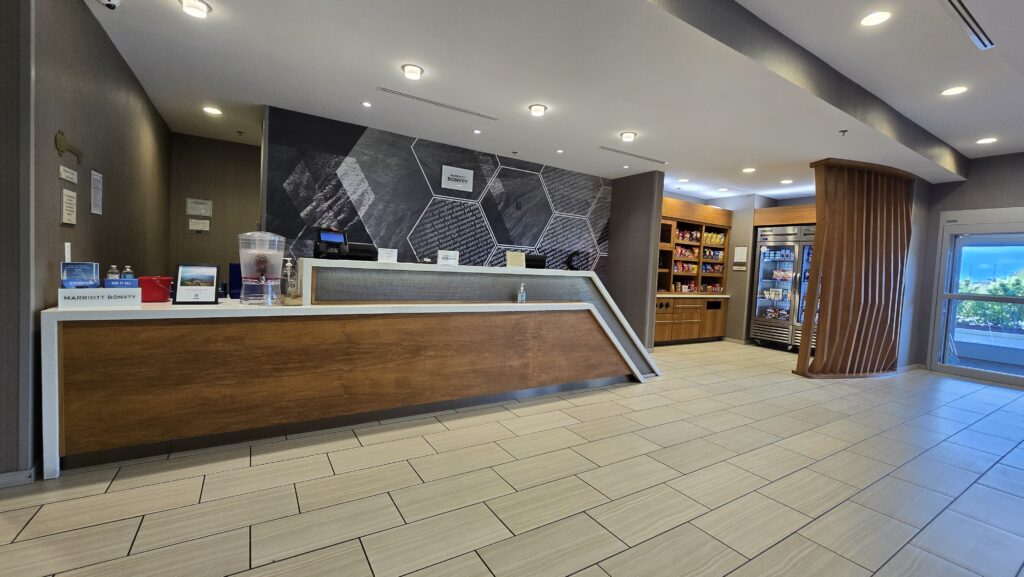
The last filter is the simplest one: has this company built what you are asking for, and can they show you? A residential kitchen shop and a commercial millwork shop are different animals, and plenty of companies are honestly only one of the two. Our work runs across both — kitchens, vanities, closets, and outdoor kitchens on the residential side, and hotels, offices, hospitals, and apartment buildings on the commercial side. We also fabricate to other contractors' drawings when the build is theirs and the shop time is ours.
Ask to see finished jobs that look like yours, not just the prettiest photo in the folder. Ask who is coming to your house to install. And ask where the company actually works — we cover Chattanooga and the surrounding area, along with Knoxville, Nashville, Jasper, and Atlanta.
The decision matrix
If you only take one thing from this post, take this table to your next appointment. Read down the left column, check the ones that describe the company in front of you, and see which side collects more of your rows.
| If the cabinet shop… | Good sign | Red flag |
|---|---|---|
| Emails you an insurance certificate | Yes | No |
| Names the box material and the hardwood | Yes | No |
| Will not put the warranty in writing | No | Yes — walk |
| Invites you in to see work being built | Yes | No |
| Answers an odd-size wall with filler strips | Depends on the room | Ask why |
| Prices the job before measuring it | Not a real number | Yes |
| Gives a firm lead time from approved drawings | Yes | No |
| Can show finished jobs like yours | Yes | Only stock photos |
The bottom line
Choosing a cabinet contractor comes down to four answers you can get in one phone call: they are insured, they can name the material, they put the warranty in writing, and they will let you see the work before you commit. A company that clears all four will usually also be the one that measures properly, draws your room before quoting it, and shows up on the day it said it would. A company that cannot clear them is asking you to take the most expensive part of your remodel on faith.
If you are collecting bids right now, call us and add one more to the pile — (423) 463-4165. Our team will set up a jobsite meeting, take the measurements, draw the room, and put a real number in front of you, and you are welcome to come see the shop and the work in progress first. There are more questions worth asking on our FAQ page, and if you already know what you need, you can send us the details and we will come out.